Late summer creates a difficult overlap for specialty pharmacy operations.
Outdoor temperatures remain high. Delivery vehicles sit in traffic. Packages move through loading areas, transfer points, and patient handoffs. At the same time, fall vaccination programs begin moving flu, RSV, and updated COVID-19 vaccines through many of the same logistics networks already handling specialty biologics, temperature-sensitive therapies, and routine refills.
A cold chain that usually performs reliably is suddenly being asked to manage higher volume under more demanding conditions.
That increases the consequences of any weakness in cold-chain delivery.
A temperature-sensitive specialty medication can be packed correctly, leave the pharmacy on time, and still encounter risk during transit. When pharmacy teams cannot see what is happening between pickup and delivery, they may not learn about a temperature excursion until the medication reaches the patient or until someone calls to report a problem.
For specialty pharmacy directors and clinical operations leaders, that is not simply a delivery failure. It can become a patient-safety concern, financial loss, operational burden, and question of liability.
Packaging Is Essential. It Is Not the Whole Cold Chain.
Insulated containers, cooling materials, validated pack-outs, and temperature-control specifications are foundational. But packaging cannot alert the pharmacy when a route is delayed, a delivery attempt fails, or a medication remains unattended longer than expected.
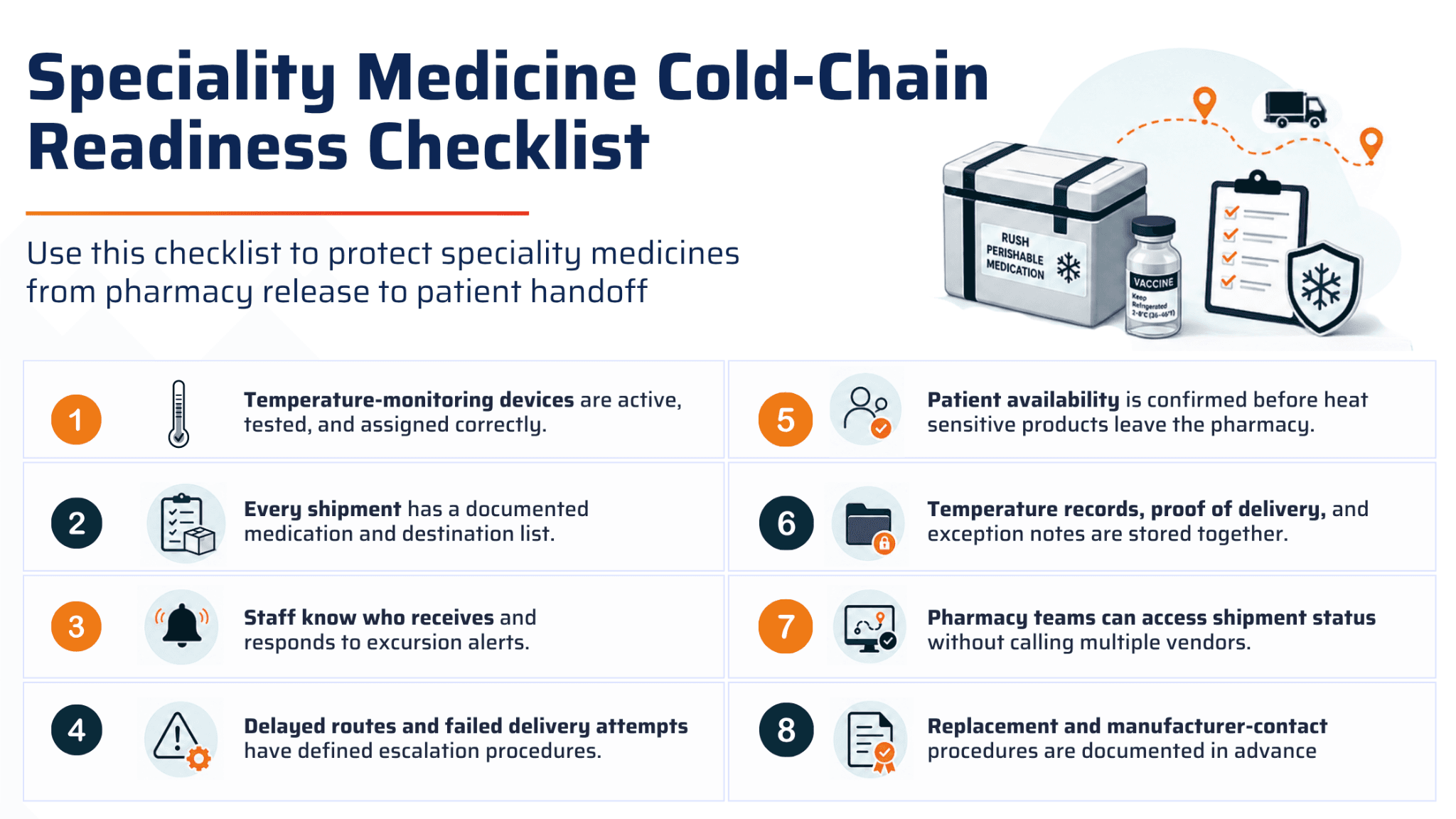
Cold-chain protection depends on visibility and accountability across the entire journey from pharmacy release through transportation and final handoff.
For pharmacy operations leaders, the question is not only, “Was this medication packed correctly?”
It is also:
Can we see the shipment’s condition during transit?
Who is actively watching for exceptions?
How quickly will the pharmacy know when something changes?
Is there a documented record of the shipment, each handoff, and the response?
The Real Cost of an Excursion Is Not Just the Medication
When a specialty medication arrives outside its validated temperature range, the immediate costs include replacement, expedited reshipment, additional staff time, and possible treatment delays.
The harder question is: What happened in transit, and can the pharmacy prove it?
For many specialty pharmacy teams, answering that still means reviewing spreadsheets, calling the courier, locating paper records, or downloading temperature data after delivery. By then, the team is investigating an incident rather than responding to a developing risk.
USP standards address pharmaceutical packaging and storage conditions, while DSCSA requires applicable product-tracing documentation as prescription drugs move through the supply chain. But neither a paper trail nor a courier’s assurance that a shipment “should have been fine” provides real-time operational oversight.
When temperature data, delivery status, handoff records, and exception notes are fragmented, teams may struggle to determine whether the medication remained suitable for use, explain what occurred, and demonstrate that established procedures were followed.
A cold-chain incident can therefore become more than a delivery problem. It can trigger a patient-safety review, operational disruption, and a time-consuming documentation challenge for pharmacy, clinical, quality, and compliance teams.
From Temperature Control to Cold-Chain Accountability
Phox Health combines GreenPhox, PhoxOS, and TRAX to create a connected cold-chain workflow that gives pharmacy teams visibility into the shipment, route, handoffs, and any exceptions that occur along the way. This reflects Phox’s broader positioning as a healthcare logistics partner connecting technology, specialized delivery operations, patient communication, and documented accountability.
GreenPhox protects the medication. Reusable, temperature-controlled packaging helps maintain required conditions during transit, while real-time temperature monitoring gives teams insight into the shipment’s condition throughout the journey.
PhoxOS connects the operational data. Pharmacy teams receive a centralized view of pickup status, route progress, patient communication, proof of delivery, and shipment documentation. Instead of relying on separate spreadsheets, phone calls, and courier updates, teams can access connected information in one place.
TRAX supports execution and exception management. The managed operational layer coordinates pickups, maintains accountability at each handoff, manages delays and failed delivery attempts, and escalates issues before they become unexplained patient-side problems.
Together, these support cold-chain delivery through:
Real-time temperature visibility: Teams can identify risk as it develops.
Documented shipping lists: Pharmacy staff have a record of what was released, where it moved, and how delivery was completed.
Live operational oversight: A care-coordination layer watches shipments, manages exceptions, and communicates changes.
Patient communication: Delivery updates help reduce missed handoffs and the time medications remain unattended.
Closed-loop documentation: Temperature history, route status, proof of delivery, handoff records, and exception notes are connected.
Across its specialty shipping operations, Phox Health has maintained zero temperature excursions and a 100% delivery success rate while transporting more than $54 million in specialty medications.
That outcome is not achieved through packaging alone. It comes from building an operating process around every shipment: validated protection through GreenPhox, connected visibility through PhoxOS, and active delivery oversight through TRAX.
The box maintains the environment. The technology shows what is happening. The operational team makes sure someone is accountable when the plan changes.
Accountability Is the Differentiator
Cold-chain packaging is table stakes. The real differentiator is knowing that someone can see the shipment, understand its condition, intervene when risk appears, and provide a documented record after delivery.
Late-summer heat does not pause when logistics volumes increase. Specialty pharmacy cold-chain operations must be prepared to protect every temperature-sensitive medication moving through the network.
With GreenPhox, cold-chain protection does not end when the package leaves the pharmacy. It continues until the medication is safely handed to the patient.
To learn how Phox Health can help strengthen visibility and accountability across your specialty pharmacy cold chain, connect with our team.