The same-day expectation consumers learned in retail is now moving deeper into pharmacy.
By the end of 2026, one of the country’s largest retail pharmacy platforms plans to offer Same-Day prescription delivery in nearly 4,500 U.S. cities and towns, bringing faster prescription access to millions more patients.
For health systems, that changes the competitive landscape.
Patients increasingly expect prescriptions to be easier to access, easier to track, and easier to receive at home. But meeting that expectation does not mean treating medication like another package arriving on the doorstep.
Pharmacy delivery still requires visibility, secure handoffs, patient communication, exception management, and, when needed, temperature control.
That creates a bigger question for health-system leaders: How do you match the convenience patients now expect without giving up the pharmacy relationship, the fill, or the operational standards healthcare requires?
Because the risk is not simply that a national retail platform can deliver faster.
It is that, one prescription at a time, the patient relationship can begin moving with it.
The Risk Is Bigger Than Losing a Delivery
When a prescription leaves the health-system pharmacy, the loss is not limited to dispensing revenue.
The health system can also lose visibility into what happens next: whether the medication is refilled on time, whether the patient stays engaged, whether questions are resolved quickly, and whether the pharmacy remains part of the ongoing care relationship.
That matters because pharmacy is not just a transaction. It can be one of the most consistent touchpoints a patient has with the health system after the clinical encounter ends.
When patients move prescriptions to outside platforms because the experience feels faster or easier, the relationship can begin to shift quietly.
One prescription becomes a refill somewhere else. One refill becomes a new default.
Over time, the pharmacy risks losing not only the fill, but also opportunities to stay connected to the patient throughout the medication journey.
That can mean less visibility into adherence, fewer opportunities for intervention, and less control over the overall medication experience.
This is why delivery should not be viewed simply as an operational convenience.
It is increasingly part of patient retention, continuity of care, and the health system’s ability to remain present after the prescription is written.
MetroHealth Shows What This Can Look Like
This is not just a theoretical model.
MetroHealth did not need to become a logistics company to offer same-day prescription delivery. Instead of building its own fleet, dispatch operation, software, and delivery infrastructure, the health system worked with Phox Health to extend its pharmacy experience beyond the hospital while keeping its own pharmacy at the center.
The challenge was bigger than getting a prescription from point A to point B.
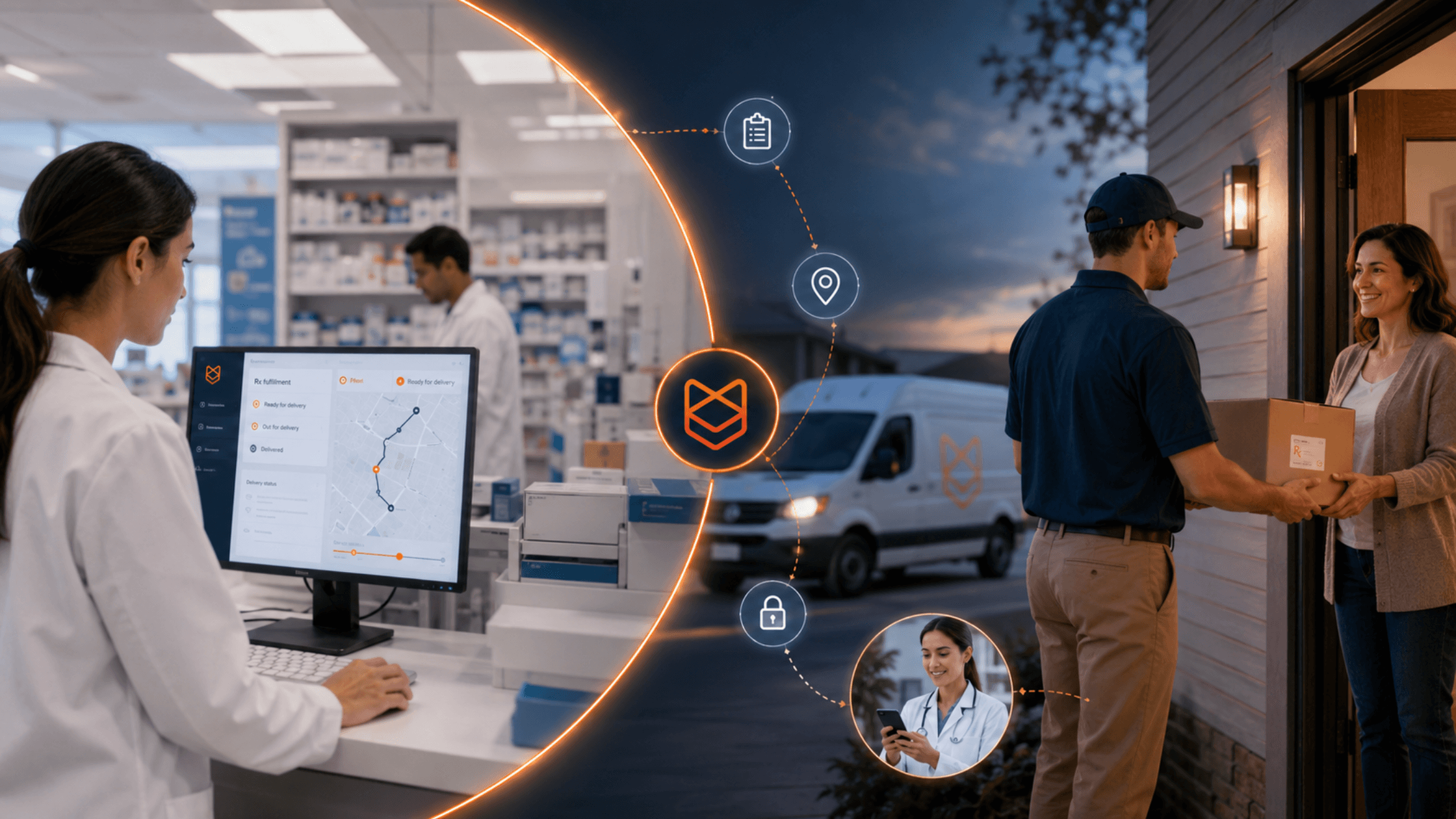
MetroHealth needed a delivery model capable of supporting virtual and in-person care while maintaining visibility after the prescription left the pharmacy. Through the partnership, delivery coordination was connected with real-time visibility, patient communication, documented handoffs, exception management, and support for urgent, specialty, and temperature-sensitive prescriptions.
The results were significant.
After fully adopting Phox Health’s delivery and software system, MetroHealth reported:
Nearly 10x growth in prescription capture
More than 99% delivery accuracy and on-time performance
Implementation of Ohio’s first compliance-friendly refrigerated medication workflow
Greater patient visibility and convenience
That matters because it demonstrates that convenience and pharmacy retention do not have to work against each other.
Patients can receive medications faster without the health system automatically handing the prescription relationship to an outside retail platform. The health system can remain part of the experience from prescribing through fulfillment and final delivery.
That is the larger opportunity.
Same-day pharmacy delivery should not be an advantage reserved for national retail platforms.
With the right operating model, health systems can make their own pharmacies easier to use, improve prescription capture, and extend the care experience beyond their facilities without building an entire logistics operation from scratch.
Fast Delivery and Healthcare-Ready Delivery Are Not the Same Thing
There is an important distinction between getting something there quickly and delivering medication responsibly.
Health-system pharmacy logistics can involve high-cost specialty medications, cold-chain requirements, controlled handoffs, patient availability, failed delivery attempts, and clinical urgency.
That means pharmacy leaders should be asking more than: “Can this get there today?”
They should also be asking:
Can our pharmacy team see what is happening?
Who owns the exception when something goes wrong?
Can the patient receive clear, timely updates?
Are handoffs documented?
Can the same model support specialty and temperature-sensitive medications?
Can we measure performance without chasing multiple vendors for information?
Speed matters.
But in healthcare, speed without visibility and accountability is incomplete.
The retail world may have trained consumers to expect faster delivery. Healthcare still has to determine what happens when the delivery is late, the patient cannot be reached, the medication requires refrigeration, or the handoff needs to be documented.
That is where a delivery service becomes a healthcare workflow.
What to Ask Your Logistics Partner Before Q1
As same-day delivery becomes more common, health systems should evaluate logistics partners based on more than speed and geographic coverage.
Before committing to a pharmacy delivery strategy, pharmacy and operations leaders should ask:
Can we keep prescriptions inside our own pharmacy network?
Can the solution work with our existing pharmacy workflows?
Can patients receive real-time, branded delivery updates?
Can pharmacy teams see delivery status and exceptions in one place?
Who actively manages failed attempts, delays, and patient availability issues?
Is proof of delivery and handoff documentation captured?
Can the same model support specialty and cold-chain medications?
How are drivers and delivery partners prepared for healthcare workflows?
What performance data will leadership receive?
How quickly can we launch without building a new internal logistics operation?
The answer to those questions will increasingly determine whether delivery simply moves a package or actually strengthens the pharmacy operation.
The Real Competitive Question
The convenience bar has moved.
Consumers already know what effortless ordering, tracking, and fast home delivery feel like. Increasingly, they will expect their pharmacy experience to meet that same standard.
Health systems cannot ignore that shift.
But healthcare does not need to imitate e-commerce to compete on convenience.
The stronger strategy is to make the health system’s own pharmacy easier to use while keeping the prescription, the patient relationship, and operational visibility where they belong.
Inside the health system.
A stronger pharmacy delivery model can improve access, reduce friction, and help health systems compete on convenience without giving up the accountability healthcare requires.
Because the last mile should strengthen the pharmacy relationship, not replace it.
Phox Health helps health systems extend that relationship beyond the pharmacy through healthcare-focused delivery operations, real-time visibility, patient communication, documented handoffs, and support for specialty and temperature-sensitive medications.
Ready to strengthen your pharmacy delivery strategy? Connect with our team to learn how Phox Health can help you launch or scale a healthcare-grade last-mile program without building it all in-house.